Bengaluru-based circular economy startup Recove Ventures has raised Rs 56.25 crore in a mix of equity and debt to build plastic recycling infrastructure in Maharashtra and expand its operations in Karnataka.
The round comprises Rs 36.25 crore in equity and Rs 20 crore in debt. New investors include Sumeet Narang, founder and chief executive of Samara Capital, non-banking lender Capri Global and the Amit Prakash Sharma Family Trust.
Existing investors also joined the round, including the family office of Chaitanya Kejriwal of Parkson’s Packaging and Ganesh Natarajan, chairman of 5F World. The company announced the fundraise on 18 November.
Where the money will go
Recove will spend the fresh capital on industrial processing facilities, distributed pre-processing centres and technology that tracks materials and checks quality. The money funds the first phase of its expansion in Maharashtra and Karnataka.
The largest project in the pipeline is a granulation plant at Additional Jalgaon MIDC in Maharashtra. It will process 1,100 tonnes of high-density polyethylene and polypropylene every month and is planned to start operations in early FY27.
A supply chain built from segregation up
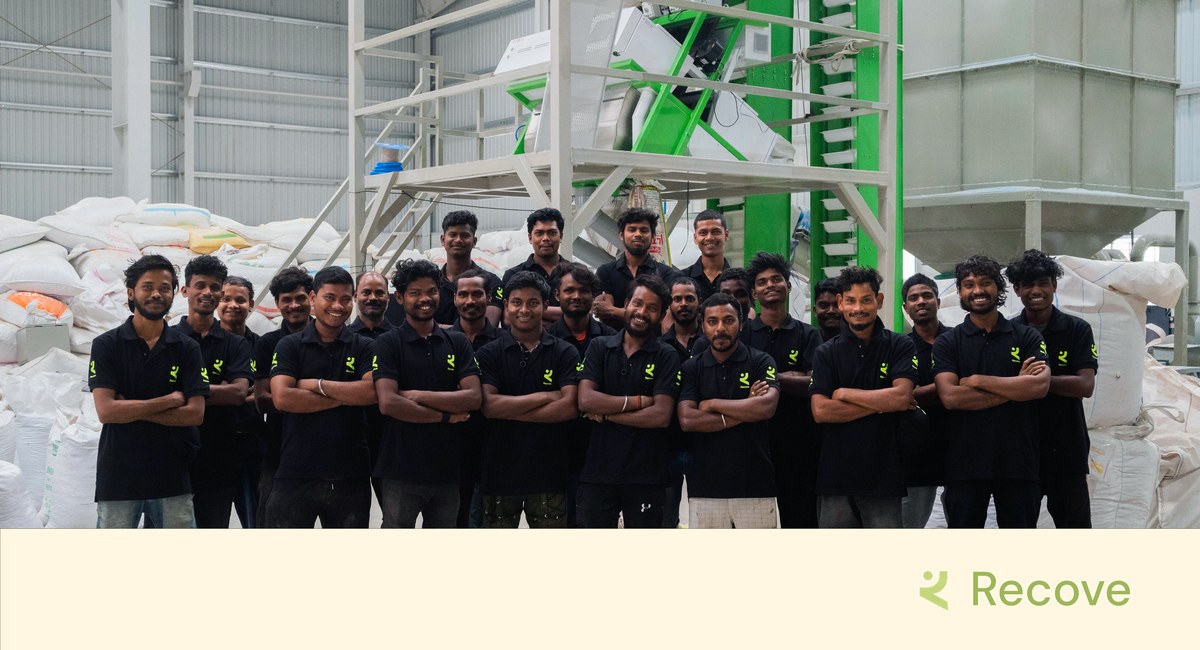
Recove sources post-consumer plastic waste and processes it into recycled material for recyclers and converters. It focuses on two plastics, high-density polyethylene, known as HDPE, and polypropylene, known as PP.
The company says quality is decided at the start of the chain. Its work begins with segregation, then moves through sorting, washing and granulation before the material reaches manufacturers.
“India’s plastic recycling industry has a quality problem, not a recycling problem. The quality of recycled plastic is decided at the very start of the chain, at segregation, and cannot be recovered downstream. That is why Recove started at segregation and is building upwards from there to deliver consistent, industrial-grade recycled material at scale.”
Viral Chhajer, Co-founder, Recove Ventures
The team behind Recove
Recove was founded in 2024 by Viral Chhajer, Kunal Kumar, Aayush Killa and Sharan Subaiah. Chhajer is a serial entrepreneur who earlier co-founded StayAbode and Smartstaff and was part of the founding team at Runnr, which Zomato later acquired.
Kumar is a former Indian Administrative Service officer of the 1999 batch. He served as joint secretary and mission director of the Smart Cities Mission from 2018 to 2024 before leaving the service to build Recove.
Scale so far
Recove says it works with more than 30 paying recyclers and converters, and around 90 percent of its customers place repeat orders. Its annualised revenue run rate has crossed Rs 40 crore.
Its washing facility at Harohalli in Bengaluru has run since late 2025 and processes about 600 tonnes of post-consumer plastic a month. A granulation line at the same site started operations in October 2026.
The company had earlier raised pre-seed funding in mid-2025 in a round led by Momentum Capital. Its revenue has grown about 12 times since that round, according to an update from the investor in May 2026.
Recove’s own live counter puts the waste plastic it has processed at more than 8.1 million kilograms, with over 16,300 tonnes of carbon dioxide equivalent emissions avoided against a virgin plastic baseline.
A decade of state partnerships
Recove has signed 10-year agreements with the governments of Maharashtra, Gujarat and Uttar Pradesh. Each agreement involves planned investments of more than Rs 500 crore.
Including its plans in Karnataka, the company aims to invest more than Rs 2,000 crore across the four states over the next decade. The Maharashtra agreement was signed at Mantralaya in Mumbai in May 2026.
The scale of the ambition matches the size of the gap. India recycles less than 20 percent of its waste plastic effectively, and Recove puts the value leaking from the economy at more than 8.5 billion dollars a year.
Regulation is pushing demand in the same direction. Extended producer responsibility rules require brands to use 30 percent recycled plastic today, rising to 60 percent within two to three years.
The round is small next to the decade-long plan, but it funds the part of the chain Recove argues matters most. If its segregation-first model delivers consistent quality at scale, the company has a clear path from a Bengaluru washing line to a national supply network.