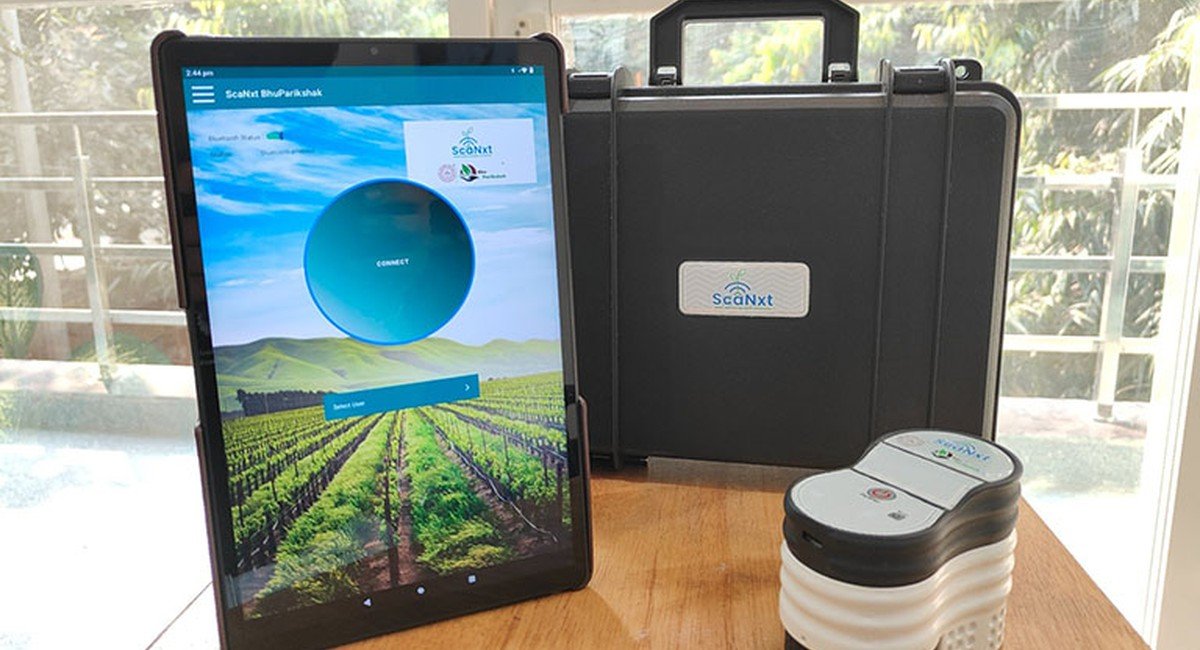
ScaNxt Scientific Technologies has raised an undisclosed sum from Rainmatter, the Small Industries Development Bank of India and the Export-Import Bank of India. The IIT Kanpur incubated agritech startup announced the backing on Thursday, and it has now joined Rainmatter’s portfolio of climate and deep tech companies.
A soil test that takes 90 seconds
ScaNxt’s flagship product is Bhu-Parikshak, a handheld device that tests soil health without chemicals. It uses near-infrared spectroscopy and machine learning to read a soil sample and return results in about 90 seconds. A single charge powers up to 250 tests, so field teams can work all day without recharging.
The device measures six soil parameters, including nitrogen, phosphorus, potassium, organic carbon, clay content and cation exchange capacity. That reading helps a farmer decide how much fertiliser a field actually needs, instead of a standard dose on every plot.
What the company has built beyond the device
Bhu-Parikshak is not the company’s only product. Its patented Detect technology and AgroLens platform give farmers real-time pest detection and crop advice, covering more of the season. The company now counts close to 90,000 registered farmers and more than 200 business customers across over 21 states.
From an IIT Kanpur lab to the field
The device began as research at IIT Kanpur, where a team led by Professor Jayant Kumar Singh developed the soil sensing technology. ScaNxt signed a technology transfer agreement with the institute in November 2024 to take the innovation to farmers in India and abroad.
Founder and chief executive Rajat Vardhan had earlier started AgroNxt as a farm advisory platform in 2016 with Ashutosh Tiwari. The team then moved from advice to hardware, building a device that a field worker can carry into a village and use on the spot.
Why these three backers matter
Each backer brings something different. Rainmatter invests Zerodha’s profits in climate, health, deep tech and fintech companies, and it has put more than Rs 1,500 crore into over 160 startups since 2016. SIDBI finances small businesses across India, while Exim Bank’s Ubharte Sitaare Programme supports Indian companies with export potential.
Rainmatter was also in the news a day earlier, co-leading altM’s 10.3 million dollar Series A for crop waste chemicals.
That combination fits a company selling hardware to farmers and looking outward. ScaNxt is already expanding its international presence, and Exim Bank sees export opportunity in its technology foundation. The funding lands as the company moves into farm machinery, after signing an agreement to commercialise an indigenously developed electric tractor.
What the backers said
Vardhan said the backing validates the company’s work on climate smart technology for smallholder farmers. Abhinav Singh Negi, who leads climate and deep tech at Rainmatter, said the firm was drawn to the mix of hardware, AI and engineering.
“Our association with Rainmatter, SIDBI and Exim Bank is a strong validation of the work we have been doing to build climate-smart, technology-driven solutions for India’s smallholder farmers.”
Rajat Vardhan, founder and chief executive, ScaNxt
“We partnered with ScaNxt because they aren’t just building software; they are combining hardware, AI, and engineering to solve tough, physical agricultural problems. Rajat and his team have shown incredible grit, taking deep-tech research from IIT-Kanpur and scaling it to 90,000 farmers.”
Abhinav Singh Negi, lead for climate and deep tech, Rainmatter
“ScaNxt’s strong technology foundation, growing international presence, and focus on developing scalable agritech solutions create promising export opportunities for the company.”
Sailesh Prasad, general manager, Ubharte Sitaare Programme, Exim Bank
Why soil health is the bigger story
Soil testing sits upstream of almost every farm decision, from fertiliser use to water and crop choice. Indian farmland averages only 0.3 percent soil organic carbon, far below the European average of 1.8 percent, which is treated as a benchmark for fertile soil.
A cheap and fast test gives a farmer a reason to act before the season, not after a poor harvest. The soil testing equipment market in India was worth about 114 million dollars in 2024 and is expected to reach about 146 million dollars by 2030.
What to watch next
Two things will show whether this backing turns into scale. The first is how quickly the farmer base grows beyond 90,000, and the second is whether the electric tractor moves from agreement to product. The amount stays undisclosed, so the next signal will be the company’s own numbers.