Two Point O Capital has raised $10 million in a Series A round led by Transition Venture Capital. Existing investor Omnivore joined the round, along with angel investors Chiranjeev Singh Saluja and Sudhir M Reddy. The company did not disclose its valuation.
The round was announced on 1 November 2026. It is a step up from the $6.3 million seed round the company raised in 2024, which was led by Omnivore. That earlier round also drew in Multiply Ventures, RTP Global, GrowX and Spectrum Impact.
Two Point O finances clean energy and water treatment projects for commercial and industrial businesses. It combines financing with project execution and monitoring, so a customer does not have to assemble the pieces itself.
The new money will let it add battery energy storage to a list that already includes solar, energy efficiency and wastewater treatment.
Where the new money will go
Most of the fresh capital will finance the deployment of clean energy assets for commercial and industrial customers. Part of it will strengthen the technology platform and support hiring. The company also plans to enter the small and medium enterprise segment and expand across India.
Over the next couple of years, it aims to build assets under management of $100 million. That target is ambitious, but recent momentum supports it.
The company says it has onboarded around 25 to 30 large customers and grown its assets under management by 1.5 times in each of the last three quarters.
The sectors in its sights use large amounts of energy and water. They include data centres, automotive, pharmaceuticals, manufacturing and healthcare. For those businesses, energy and water are major operating costs, not side issues. A system that cuts those costs without a large upfront payment is easier to approve than a capital project.
Why financing is the bottleneck
Large clean energy projects have long attracted capital. Factories, warehouses and office parks have not had the same access. Their projects are smaller, more varied and harder to underwrite one by one. That gap is the problem Two Point O was built to solve.
The company uses artificial intelligence and machine learning to assess projects, evaluate financing risks and monitor asset performance. That platform matters because distributed projects live or die on underwriting. A lender must judge many different sites, equipment types and customers without slowing each deal to a crawl.
Its structure also tells a story about how it operates. A wholly owned non-banking financial company subsidiary handles loan disbursals, while a separate operating entity covers lease and service based requirements. Financing, turnkey delivery and equipment leasing therefore sit under one roof, but the lending itself sits in a regulated vehicle.
Two Point O puts the annual opportunity in this space at $100 billion to $150 billion. That figure is the company’s own estimate, and it should be read as a statement of ambition rather than a measured market size. Even a small share of it would support a large financing business.
A founding team built for this problem
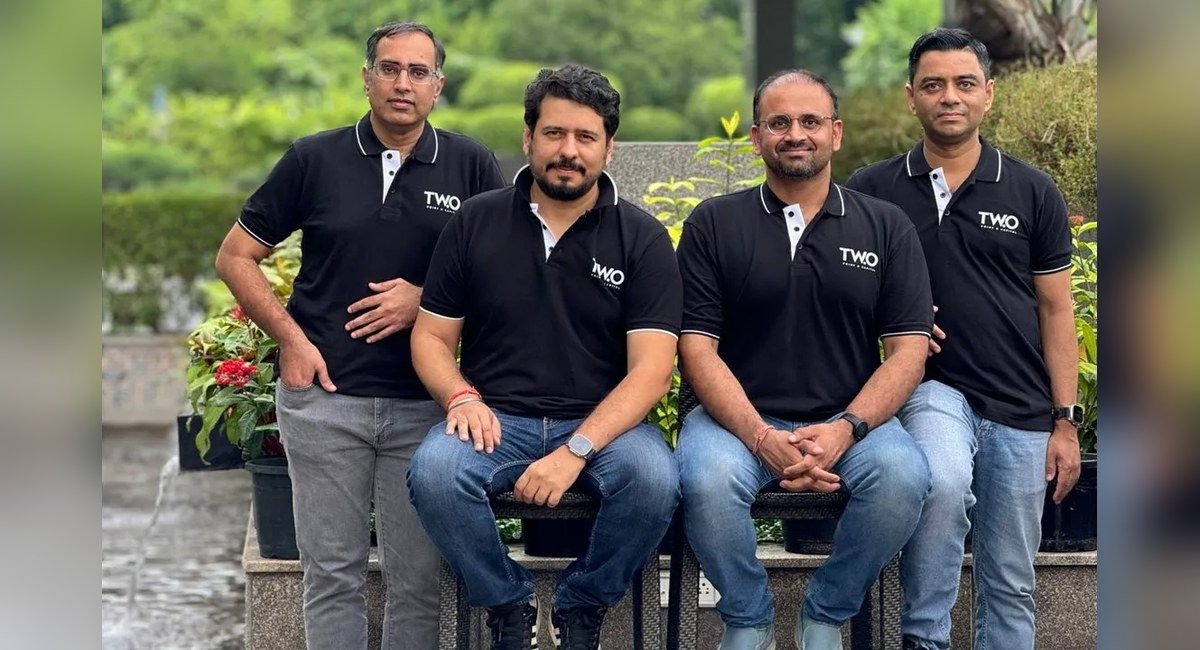
Two Point O was founded in 2024 by Archit Mehrotra, Karan Bhutani, Manya Ranjan and Shashidhar Reddy. The four came together in early 2023 to look for opportunities in clean technology financing, and Shashidhar Reddy joined the team a year later.
Their combined experience exceeds 75 years across firms including KKR, McKinsey, Shell, BP, Honeywell, ReNew, Sterlite Power and GIC.
That background shows in the customer list. Two Point O works with original equipment manufacturers and engineering, procurement and construction firms across India. Its named customers include Premier Energies, Godrej, JK Tyre, Morepen Pharma, Wipro and Phoenix Mills. Those are not early pilot names. They are large buyers whose projects must work at scale.
This funding will accelerate our vision to become India’s first and largest multi-asset and multi-solution platform enabling adoption of clean energy by C&I customers.
Karan Bhutani, chief executive and co-founder of Two Point O, set out that ambition in the funding announcement. The phrasing matters because it frames the company as a platform, not a single product lender. Battery storage is the next asset class, but the model is designed to add more.
Two Point O removes the capex barrier, accelerating the adoption of clean energy solutions. The industry often underestimates the complexity of integration across a fragmented ecosystem with multiple stakeholders. By taking end-to-end ownership of execution, Two Point O enables customers to focus on their core business rather than managing the build.
Yashodhara Bakliwal, vice president of investment at Transition Venture Capital, made that point in the same announcement. It captures the real sales pitch. The customer buys an outcome, lower energy and water costs without managing a build, rather than a loan or a set of solar panels.
What the round changes
The Series A does not change the business model. It changes the scale at which the model can run. Battery storage adds a new asset class at a time when industrial customers need power reliability as much as clean power. The small and medium enterprise push tests whether the platform works beyond large customers.
The next proof points are straightforward. The company must convert its customer pipeline into deployed assets, hold its underwriting discipline as volumes rise, and show that assets under management can reach $100 million without a drop in quality. The funding gives it room to try. The results will show whether the platform scales.