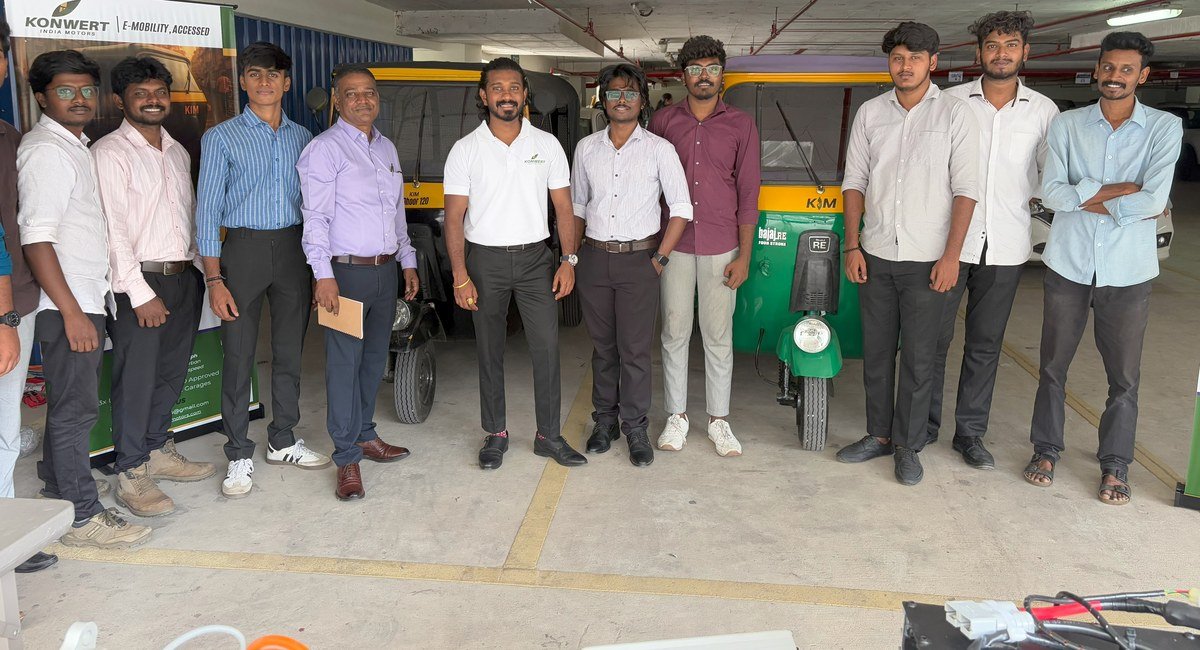
Coimbatore-based Konwert India Motors has raised a pre-Series A funding round led by The Chennai Angels, with existing investors Campus Angels Network, Keiretsu Forum Chennai and Native Angel Network also participating.
The company announced the round on October 23, 2026, and did not disclose the amount raised. The money will fund sales growth, a wider product range and expansion into new markets in India and abroad.
What Konwert Actually Builds
Konwert converts petrol, CNG and LPG auto rickshaws into electric vehicles instead of asking drivers to buy a new one. Its patented process uses a magnet-free motor and completes the conversion in about 90 minutes.
A retrofit costs roughly half the price of a new electric auto rickshaw. Converted vehicles offer up to 213 kilometres of range on a 10 kWh battery, and drivers save an estimated Rs 12,000 to Rs 15,000 a month on fuel.
That fuel saving is about a quarter of a typical driver’s monthly income. Servicing is handled through roughly 800 myTVS touchpoints across India, and four lending partners offer financing for the conversion.
A Founder Building for Drivers, Not Fleets
Konwert was founded in Coimbatore in 2019 by Nickendra Manikandan, a mechanical engineer with experience in motorsport engineering and at Renault Nissan. He has spent six years building a product aimed at drivers who cannot afford a new electric vehicle.
Every auto-rickshaw we convert belongs to a driver who keeps their vehicle, cuts their fuel bill and takes home more each month. We are now in our scaling phase, and this round lets us reach more cities, more vehicle types and more markets.
Konwert already operates in India and Sri Lanka and is developing retrofit kits for light commercial vehicles. Its website lists retrofit kits priced from Rs 1.75 lakh, with battery leasing that cuts the upfront entry cost by up to 45 percent and daily repayments from Rs 150.
Why Retrofits Matter, and Where the Risks Sit
Most of India’s auto rickshaws still run on fossil fuels, and a new electric three-wheeler remains out of reach for many owner-drivers. Konwert’s bet is that upgrading the vehicle a driver already owns is faster and cheaper than replacing it.
That logic faces real tests. Retrofits must stay reliable across thousands of vehicles, service quality must hold up beyond the first cities, and buyers may still prefer a new vehicle that carries a factory warranty.
The Chennai Angels, founded in 2007, has invested more than Rs 200 crore across over 100 startups. Its backing gives Konwert patient early capital, but the undisclosed round size leaves the scale of that backing unclear.
Konwert is not the only electric mobility bet finding early backers. KeeVurds earlier covered Snap-E Cabs and its $2.5 million raise for electric ride-hailing, a different answer to the same electrification question.
Our Take
The driver economics are the strongest part of this story. A conversion that halves the upfront cost and returns a quarter of monthly income in fuel savings solves a real problem for owner-drivers.
The open questions are scale and proof. Konwert must show that 90-minute conversions hold up at volume, that its service network keeps drivers moving, and that overseas expansion does not stretch a young team too thin.
If it clears those tests, retrofits could electrify India’s streets faster than new vehicle sales alone. If it does not, the company will still have shown that the cheapest electric auto is the one already on the road.