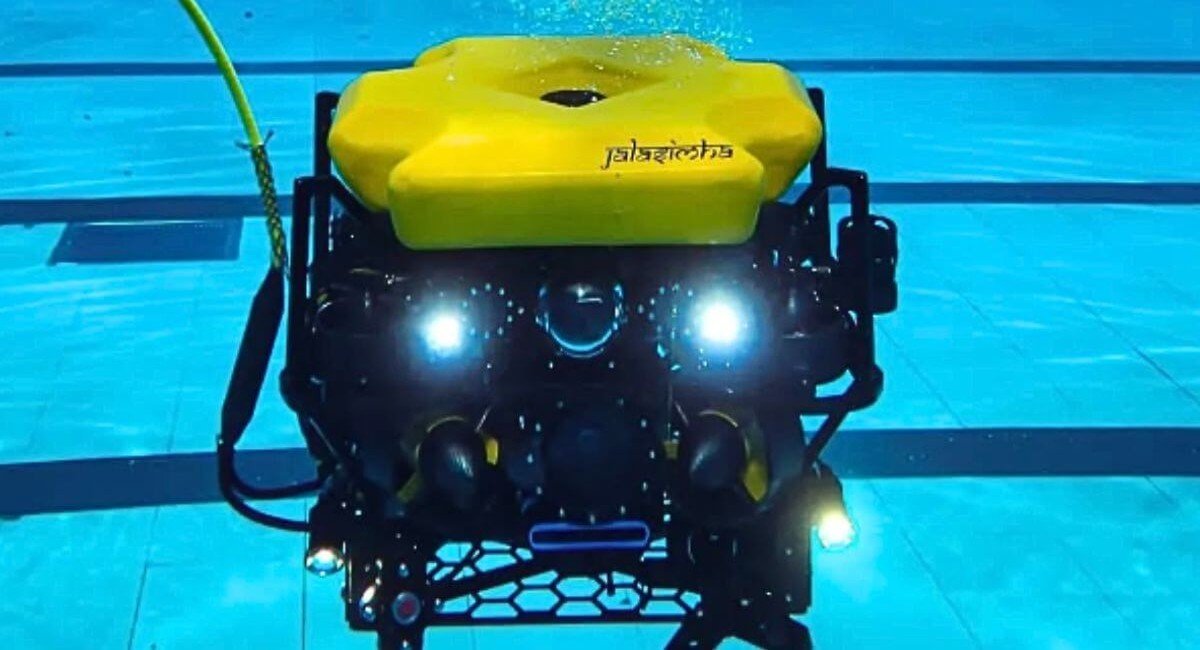
Coratia Technologies has raised Rs 18 crore in a bridge funding round led by MGF Kavachh. The Rourkela-based underwater robotics company will use the money to deliver its Rs 66 crore Indian Navy contract and to scale manufacturing for defence and critical infrastructure work.
The round was announced on 29 October 2026. It follows a Rs 17 crore pre-Series A round in 2025 from MGF Kavachh, Piper and the Small Industries Development Bank of India, taking the total disclosed funding across the two rounds to Rs 35 crore.
What the Navy contract actually requires
The Indian Navy contract was signed in September 2025 under the Innovations for Defence Excellence programme, known as iDEX. It covers the supply and maintenance of indigenously developed underwater remotely operated vehicles for ship hull cleaning, minor salvage work and inspection of submerged infrastructure.
That order changes what this funding round is for. The company is no longer raising money only to prove that its robots work. It is raising money to build, deliver and support them at the scale a naval programme demands, while continuing research on new products.
A robot built for Indian waters
Coratia builds remotely operated vehicles that a pilot controls from the surface and autonomous systems that navigate on their own. Its flagship Jalasimha underwater remotely operated vehicle has reached Technology Readiness Level 9, the highest level on the scale, which signals readiness for operational deployment.
Indian waters present unique challenges, including high turbidity, silt, low visibility and changing currents. Our focus is on miniaturising technology while advancing our systems’ intelligence, capability and deployability across defence, infrastructure and industrial applications.
Debendra Pradhan, co-founder and chief executive of Coratia, made that point when the round was announced. The point about local conditions matters because imported designs are often tested in clearer and calmer seas.
Coratia says its systems must cope with silt-laden rivers, working harbours and estuaries where visibility can fall below one metre and where currents and salinity shift with the season.
Its platforms combine cameras, sonar, multibeam sonar, Doppler velocity logs and ultra-short baseline navigation with specialised inspection payloads. Depending on the configuration, they can also carry robotic manipulators and thickness gauges for checking metal corrosion and defects on submerged structures.
Jalasimha is designed to operate at depths of up to 300 metres. Its sibling Jaladuta is a commercial remotely operated vehicle rated to 150 metres and built for hull cleaning, minor salvage and surveys of submerged civil infrastructure.
From a college project to a naval supplier
Coratia was founded in 2021 by Debendra Pradhan and Biswajit Swain, both mechanical engineering graduates from the National Institute of Technology Rourkela in 2017. The pair met on a student underwater robotics team and later returned to the idea full time after working in corporate jobs in India and abroad.
Their student team worked on a Ministry of Earth Sciences challenge to build a robot that could navigate underwater on its own and hit a target.
The team won nationally and then placed second at the Singapore Autonomous Underwater Vehicle Challenge, an early sign that the engineering could stand up beyond a classroom project.
The company was incubated at the National Institute of Technology Rourkela and later appeared on Shark Tank India in its third season. Its own awards list includes winning the iDEX DISC 7 challenge in 2022 and a Rising Star award at the Sangam Conclave in 2025.
Beyond the Navy, its clients and partners include Indian Oil, Indian Railways, Tata Steel, Hindalco Industries, the Steel Authority of India, Neelachal Ispat Nigam, Jindal Steel and Power and the National Institute of Technology Rourkela.
The same inspection technology also applies to dams, reservoirs, ports, bridges, pipelines, offshore assets and subsea communication networks for inspection and monitoring.
Why MGF Kavachh is doubling down
MGF Kavachh had already backed Coratia before the Navy order arrived, and this bridge round is a follow-on investment rather than a first bet. The fund focuses on Indian companies working on strategic problems linked to technological self-reliance, including defence, aerospace, critical communications, semiconductors and critical materials.
The Navy contract sits inside a wider push to bring startups into defence supply chains. iDEX, the Ministry of Defence programme launched in April 2018, funds and supports startups and small firms developing technology for the armed forces, and Coratia won its challenge in 2022 before the larger contract followed.
Coratia is not the only defence-focused manufacturer raising money this week. Venttup, a Bengaluru precision manufacturing startup, also raised fresh capital to build capacity for defence and aerospace work.
The next test is delivery. The bridge round gives Coratia room to manufacture and deploy, but the Navy programme will judge it on systems working reliably in service, not on the funding announcement itself.