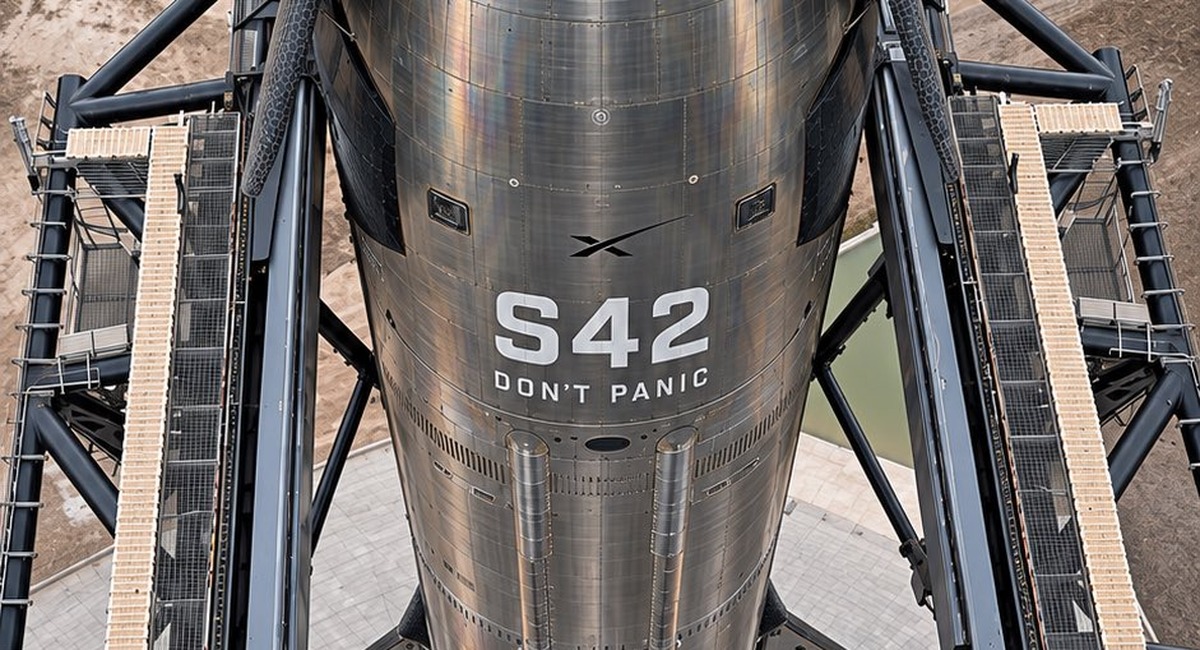
SpaceX caught its Starship spacecraft with the giant arms of its launch tower on Saturday, after the vehicle spent about 22 hours in orbit. The catch is the first time a spacecraft returning from orbit has been caught in mid-air.
The spacecraft, known as Ship 42, lifted off from Starbase in Texas on Friday evening on top of the Super Heavy booster. It circled Earth 14 times, released 26 Starlink satellites, and then flew back to the same tower it had left a day earlier.
A flight that ended where it began
Ship 42 fell out of thick cloud over the Texas coast on Saturday afternoon and reignited three of its engines to flip itself upright. It slowed to a hover and settled onto the tower arms, with two fittings near its top taking the weight.
The catch came about 22 and a half hours after liftoff, early on Sunday morning in India. The flight lasted longer than any Starship mission before it, and it was only the second time a Starship upper stage had reached orbit at all.
The vehicle flew at an altitude of about 265 kilometres. SpaceX said everything on the spacecraft, including its heat shield, appeared to work well during the flight.
“Mechazilla catches Starship! Congratulations to the entire SpaceX team on this incredible achievement!”
SpaceX, in a post on X
Within hours of the catch, Elon Musk and SpaceX engineers began inspecting the ship at the tower. Musk shared photos from the tower and wrote that Ship 42 looked great after its journey.
The booster did not make it home
The mission had aimed for a double catch, with the Super Heavy booster returning to the tower minutes after liftoff. That part of the plan failed on Friday evening.
About six and a half minutes into the flight, the booster called off its own return. SpaceX said its guidance system detected a problem on the way back, and the vehicle was diverted to the Gulf of Mexico, where it was lost.
SpaceX later said the booster’s boostback burn had ended early after a low fuel alarm, and engineers are still investigating what triggered the abort. SpaceX has not said whether Ship 42 will fly again.
The setback leaves one half of the reusability plan unproven on this flight. SpaceX had already caught Super Heavy boosters before, most recently in March, so the technique itself is proven.
Why the catch changes the plan
SpaceX was founded by Elon Musk in 2002 with the goal of cutting the cost of space travel, and reusability sits at the centre of that plan. Catching the Ship matters because every part of the vehicle is meant to fly again with little work between flights.
A recovered Ship can be inspected, refuelled and flown again instead of being built from scratch. That is the model SpaceX already uses for its Falcon 9 boosters, and Starship extends it to a far larger vehicle.
The flight also carried 26 Starlink V3 satellites, the newest version of the internet satellites. All 26 were deployed after reaching orbit and made contact with the ground.
NASA has selected Starship as the lunar lander for its Artemis programme, which aims to return astronauts to the Moon. NASA Administrator Jared Isaacman welcomed the catch on X.
SpaceX expects to start launching Starships from Kennedy Space Center in Florida within the next few months. The next test flight will show whether the booster catch can be repeated alongside the Ship.
The catch answers the biggest open question about Starship. The booster miss is a reminder that the system still has rough edges, but a spacecraft that can leave orbit and land in the arms it launched from is no longer a theory.