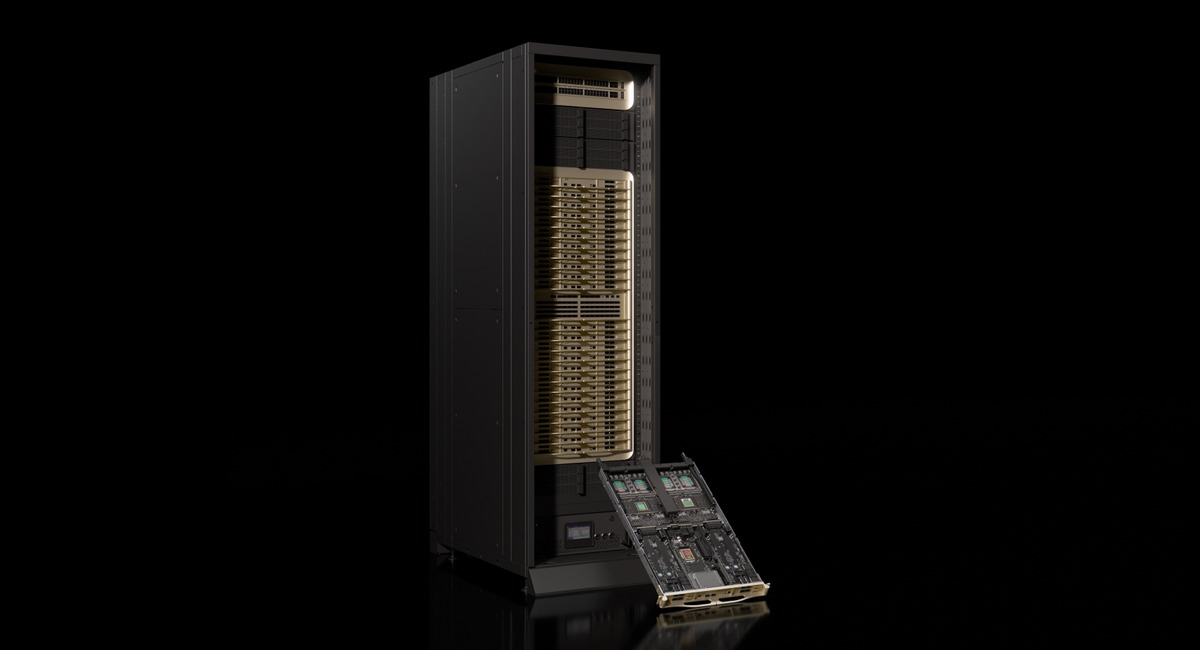
NVIDIA has unveiled Rubin HPC, a new graphics processor built to accelerate the simulations that AI agents use in science and engineering. The company announced the chip on 16 November 2026 at SC26, the supercomputing conference in Chicago.
The headline number is the core count. Rubin HPC packs more than 50,000 CUDA cores onto a single GPU, a record for NVIDIA. The standard Rubin GPU carries 28,672 cores, so the new chip nearly doubles that figure.
A chip built around data movement
Raw core count is only part of the story. Scientific workloads reach into immense datasets, gather a handful of scattered values, calculate a result and repeat that pattern at enormous scale. Rubin HPC adds sparse data acceleration so its cores stay supplied with data instead of waiting for it.
Seventh-generation NVLink handles communication between GPUs, while the design scales data movement and compute together rather than raising compute alone. Ian Buck, NVIDIA vice president of hyperscale and high-performance computing, put it plainly.
“For agents tackling science and engineering, faster simulation means faster discovery.”
Ian Buck, vice president of hyperscale and high-performance computing at NVIDIA
Why agents need faster simulations
Agents help scientists and engineers explore more candidate materials, molecules and designs than a human team could test by hand. Simulations test those ideas and guide the next steps, so faster simulation shortens the loop from hypothesis to discovery.
The workloads span climate models, engineering simulations, genomic analysis and financial risk. NVIDIA pairs the chip with its CUDA-X libraries, which offer optimized implementations of the algorithms agents use most, including those built for simulation and analytics.
Where Rubin HPC sits in the Vera Rubin platform
Rubin HPC is one part of the Vera Rubin platform, which NVIDIA describes as five purpose-built rack-scale systems combined into a single AI supercomputer for multi-step reasoning and long-context agent work. The platform is now in full production.
The related NVL4 system, which links four Rubin GPUs with two Vera CPUs, delivers up to four times the scientific simulation performance of the previous Hopper generation on NVIDIA’s own comparison. Rubin HPC itself is expected to be available in 2028.
NVIDIA has not published memory capacity, power draw, a price or benchmark results for the chip. Buyers planning 2028 systems still have no figure that shows how fast it would run their own workloads.
The launch lands on results day
The timing adds a second reason to watch NVIDIA this week. The company reports its fiscal third-quarter 2027 results on 17 November, after the United States market closes, with the earnings call at 5 p.m. Eastern time. It guided revenue to $108 billion, plus or minus 2 percent.
It is the first results update since Jensen Huang resigned as chief executive on 12 November, with chief financial officer Colette Kress serving as interim chief executive. The quarter being reported ended on 25 October, so the figures describe the business under the previous leadership.
For now Rubin HPC is a statement of direction rather than a product buyers can order. Its real test will come when systems ship in 2028, and the first read on demand may come from the outlook NVIDIA shares with its results tonight.


