LG AI Research has opened free access to the application programming interface for K-EXAONE 2.5, its upgraded AI foundation model. The company announced the move on 9 November 2026 at NVIDIA AI Day Seoul, held at COEX in Seoul.
Developers, startups, companies and research institutions can now use the model at no cost for service development and research. They only need an API key from the EXAONE API Platform.
A 750-billion-parameter model built for agentic work
K-EXAONE 2.5 carries 750 billion total parameters, with 31 billion active on each token. It works with text only, in Korean and English, and supports a context window of 512,000 tokens. Its knowledge runs to January 2026.
The model is a technology validation version, built by adding further training to K-EXAONE 2.0, which LG released in August 2026. That earlier model was open-weight under the Apache 2.0 licence, with 37 billion active parameters and a context window of 262,144 tokens.
LG positions the new model for agentic AI, where software plans tasks and uses tools on its own. The company points to code generation, debugging, refactoring and test writing, plus web search and automation with software tools.
How it scores against DeepSeek and GLM
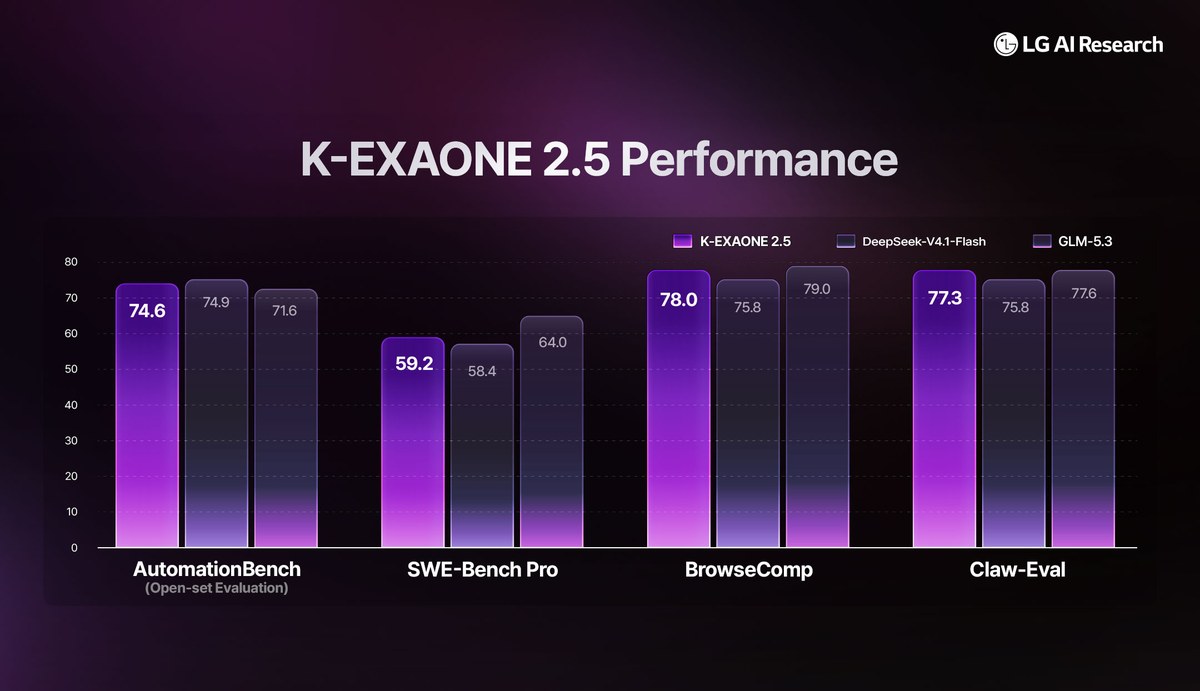
LG measured the model itself on open datasets and published four agentic benchmark scores. K-EXAONE 2.5 scored 59.2 on SWE-Bench Pro, 78.0 on BrowseComp, 74.6 on AutomationBench and 77.3 on Claw-Eval.
Those numbers sit close to DeepSeek V4.1 Flash and GLM 5.3, the two Chinese open-weight models LG uses as its reference points. K-EXAONE 2.5 leads DeepSeek on three of the four tests and trails GLM on three, so the honest reading is parity rather than a clear lead.
These are LG’s own measurements, not independent results. Readers should treat them as the company’s claim until outside groups reproduce the scores on the same tests.
Free access is a test run for a bigger model
The free API is also a trial. LG calls K-EXAONE 2.5 a technology validation model, and the training methods it proves will feed into the company’s third-round model. Real usage now gives LG feedback it cannot get from its own test sets.
LG’s internal analysis puts the performance gain at more than 70 percent across 24 benchmarks, compared with the August release. That figure comes from the company’s own tests, and LG has not published the underlying method in full.
“We will focus on completing an EXAONE model with frontier-level performance by January next year.”
Lim Woo-hyung, co-head of LG AI Research
The model sits inside Korea’s sovereign AI programme, which aims to build homegrown foundation models and cut reliance on foreign systems. K-EXAONE 2.0 was the second model LG built under that programme.
What builders should know before they start
The API follows the OpenAI chat completions format, with the model name k-exaone_v2.5, so existing tools can call it with little change. LG lists tool calling, structured outputs, code generation and streaming among the supported features.
Two gaps remain open. LG has not said how long the free access lasts, what usage limits apply, or whether the 2.5 weights will ever be released. The 2.0 weights were open, but the 2.5 release covers API access only.
LG is also looking at NVIDIA’s Dynamo technology to improve inference efficiency, and it is pursuing technical cooperation with NVIDIA. That work is still at the review stage, and no signed partnership has been announced.
The release lands in a crowded week for agent-style AI. Mistral opened the weights of its trillion-parameter Large 4 model on 29 October, and Cashfree launched a checkout built for AI agents on 7 November.
LG’s free API gives smaller teams a no-cost way to test the same kind of agentic work. The question now is whether the model’s lab scores hold up once developers put it into real products.