Google has launched Gemini 4 Hydrogen, a fast model built for everyday coding and AI agent work. The company announced the model on 12 November 2026. Google says it brings cutting edge intelligence to everyone, with speed and efficiency at the centre of the design.
Hydrogen sits below the frontier models in the same family. Gemini 4 Carbon and Gemini 4 Argon handle deep, long horizon reasoning on hard problems. Hydrogen is built for rapid execution across the many smaller steps that fill a working day, from writing code to running tests and checking results.
Speed is the point
Google positions Hydrogen as a major upgrade for teams moving from Gemini 3.8 Flash. At its default high thinking setting, the company says Hydrogen finishes tasks 2.5 times faster than 3.8 Flash. Its Terminal-Bench 4.1 score rises to 57 percent, against 18.2 percent for 3.8 Flash.
The same comparison shows fabricated claims falling by more than five times. Google also says Hydrogen adapts cleanly when a tool call fails or a search returns nothing, a common failure point for agents that run long chains of steps without human help.
On the Artificial Analysis Intelligence Index, Hydrogen scores 51 at its default high setting, one point ahead of Argon at 50. At its highest thinking setting, the score reaches 54. These are Google’s own reported figures, and no independent replication has been published yet.
Four thinking levels
Hydrogen ships with four thinking levels, called low, medium, high and xhigh. High is the default, and xhigh is new with this model. Each level trades reasoning depth against latency and cost, so a team pays only for the depth a task needs.
Google says the levels scale in a smooth and predictable progression. Across them, Hydrogen matches or beats competing models in its class while often finishing faster and using fewer output tokens, according to the company.
Hydrogen pairs with Carbon in Antigravity
Google is also launching Orchestrator in Google Antigravity, its agent first development platform. Orchestrator switches between models inside one session, rather than running a single model from start to finish. Carbon can act as coordinator while Hydrogen powers worker and verifier agents in parallel.
On Terminal-Bench 4.0, Google says Orchestrator reached near Carbon task success rates while using 24 percent less quota and finishing 19 percent faster. Orchestrator is rolling out to Google AI Ultra subscribers, and Hydrogen in Antigravity is available to paid Google AI Pro and Ultra subscribers.
Search and the Gemini app get the upgrade too
Hydrogen is not only a developer model. Google is rolling it out globally across AI Studio, the Gemini API, Gemini for business, the Gemini app and Google Search. It is also coming to Gemini in Google Sheets for eligible business subscriptions.
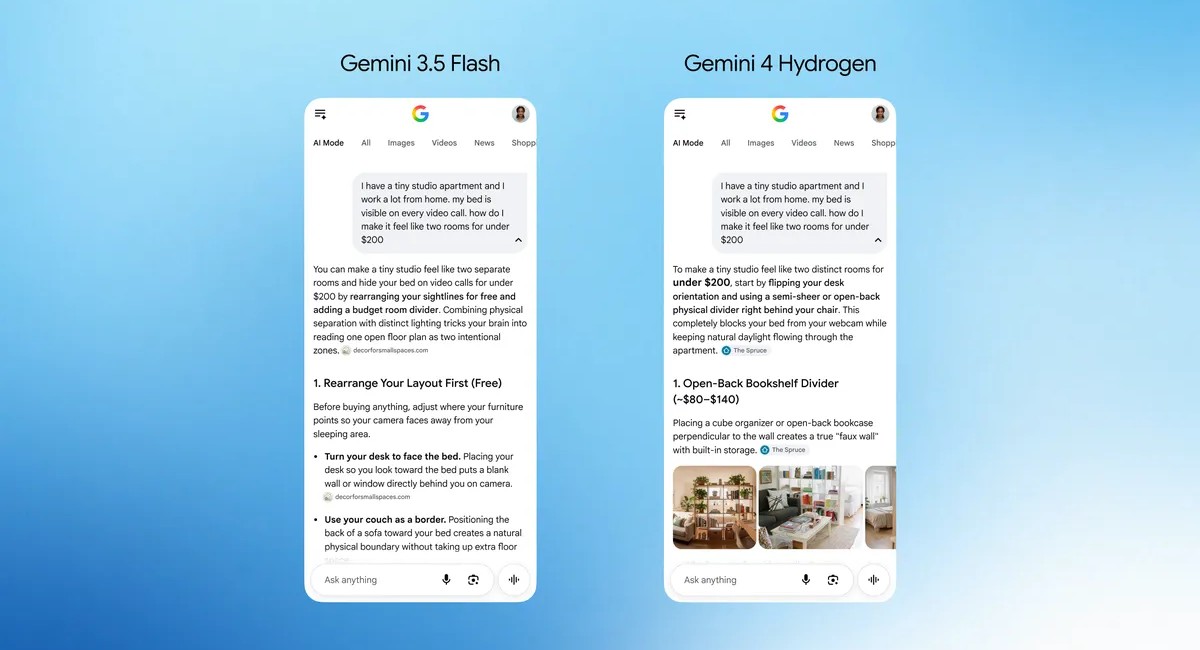
In Search, Google calls the change its biggest model upgrade yet. The company says Hydrogen understands intent better and returns more visual and easy to scan responses. It also widens the range of links Search surfaces, connecting users to sites they might not otherwise have found.
In the Gemini app, Google says Hydrogen follows instructions more closely across multi turn conversations. It calls the right tools more often, pulls context from uploads and connected apps such as Gmail and Google Drive, and produces drafts that need less rework.
What it costs
Hydrogen is priced flat across its entire one million token context window. Input tokens cost $1.50 per million and output tokens cost $7.50 per million. The flat structure removes the price steps that usually apply as context grows, which matters for agents that read large codebases.
The pricing lands between the cheap end of the market and the frontier tier. Google is betting that teams will pay a little more than the cheapest models charge if the work gets done faster and with fewer retries.
A crowded week for AI models
Hydrogen arrives in a busy week for model launches. KeeVurds covered Gemini 4 Carbon on 11 November, when Google put its flagship model into humanoid robots on a Mercedes factory line. Anthropic released Claude Fable 5.2 on 9 November, according to the BenchLeader release tracker.
The pattern is now clear across the big labs. Each family is splitting into a flagship that reasons deeply and a faster model that does the routine work. The race is no longer only about the smartest model. It is about which lab can run everyday work fastest and cheapest.
For developers, the practical question is simpler. Hydrogen is available today in Google AI Studio and through the Gemini API, and it reaches everyday users through the Gemini app and Google Search. The full announcement is on the Google blog.